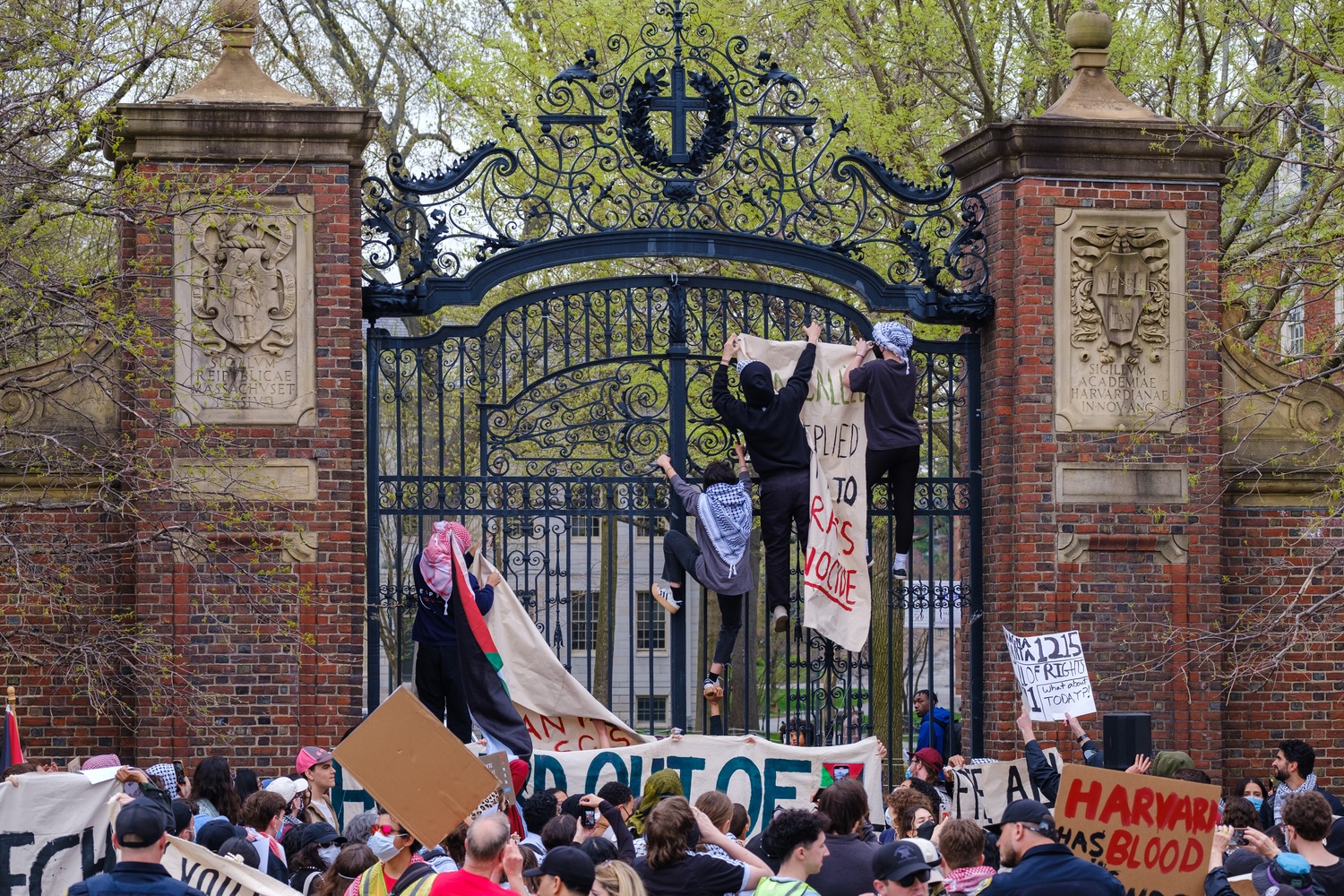
Elite colleges are under scrutiny now more than ever, from everyone. The political right sees them as “brainwashing institutions” of the highest order and the left has condemned them for being temples of privilege. And when it comes to geopolitical tensions, specifically in regards to Israel and Palestine, their campuses have become ground zero for much of the cultural warfare that is so prevalent in American politics. But beneath these cultural battles lies simpler truths: elite colleges have clear benefits, but are also elitist, full of ignorance, and most of the discourse about them is childish.
The Political Circus
Previously, we saw protests at colleges where hundreds of faculty and students were arrested, leading to police brutality and destruction. Criticism comes from both ends. Pro-Palestine advocates accuse these institutions of yielding to the interests of the State of Israel and pro-Israel advocates believe that they are hosting antisemitism.
While these protests took place in nearly every state in the country, the biggest names remain the epicenters. Everything bubbled over after the infamous Congressional hearing in 2023 from former Harvard President Claudine Gay, former UPenn President Liz Magill, and current MIT President Sally Kornbluth. When Representative Elise Stefanik asked if calls for the genocide of Jews would violate the university codes of conduct, they were unable to denounce antisemitism. This testimony was so disastrous that it resulted in Gay and Magill resigning amidst both public outrage and outrage from within their universities. On the other hand, Sally Kornbluth of MIT has stayed out of the fire by appeasing the Trump administration. Was it probably the reasonable thing to do? Perhaps. The prospect of international students being able to attend our universities is quite important for the future and I don’t entirely blame them for giving in to safeguard that.
Were Stefanik’s questions designed in bad faith because of their exaggeratory nature? Almost certainly. But I don’t see why these academic leaders were unable to articulate a rational stance. As a supporter of Palestinian rights myself, I even believe that the left has done an absolutely horrendous job with their advocacy.
Nowadays, the biggest ongoing fight is at Harvard. Yes, funding and departments around the country are at risk. Even Terry Tao and the Institute for Pure and Applied Mathematics (IPAM) at UCLA are under serious fire. And Harvard is no exception; President Trump has specifically targeted the pro-Palestine activists for their “anti-Semitism” by not only cutting their funds in the millions but also by capping the amount of international students able to enroll. What’s even more troubling is the idea that a $500 million dollar agreement between Harvard and the Trump administration was up in the air. Unlike Columbia, who bent the knee entirely by paying $200 million to the Trump administration to restore their funding, Harvard President Garber still intends to thankfully settle the matter in court.
And this absolute clownshow is happening while ICE has run rampant around the country and at campuses. The point here is part of a larger one. America’s universities are under fire. And while the cultural and political issues are complex, there are a ton of underlying problems that extend beyond that which are far more simple. Before I discuss those, I want to preface that I have a lot of respect for what these universities have contributed to our country. Economically, culturally, and nearly every field of STEM is influenced massively by these schools and we owe a lot to them. I still encourage everyone to go to college. But this tradeoff that we will unfortunately have to accept for the foreseeable future is becoming overwhelming.
The takeaway here is that many of the people leading these universities have jeopardized the future of the country through their incompetency to deal with political tension.
Money and Elitism
Elite private institutions around the country have accrued billions of dollars in endowment. The five schools with the largest endowments—Harvard, Yale, Stanford, Princeton, and MIT—have nearly $200 billion. Most of the largest donations are subject to conditions; in other words, colleges are forced to spend the money in certain ways. There is perhaps nothing more representative of how ignorant higher education has become than this.
To understand the problem, we need to acknowledge that elite universities are disproportionately represented in many of the most powerful positions in the country politically. The Supreme Court, for instance, has been overwhelmingly Ivy league. Justices Gorsuch, Jackson, and Kagan are from Harvard law school. Justices Alito, Kavanaugh, Sotomayor, and Thomas are from Yale law school. The trend continues, albeit not as dramatically, into positions in other branches of government, where Harvard specifically is overrepresented.
A normal human being would probably wonder: Isn’t it strange that a series of universities that comprises such a small fraction of all students in the country takes up such a significant portion of some of the most powerful positions in the most powerful country on Earth? Well, the reality is that prestige is pretty high up on the totem pole.
And that’s the thing, getting accepted to an elite school gets you on the same pipeline as many of the most powerful people on the planet. Outside of politics, it might mean working with people who end up at the likes of Stanford medicine or Google. And that’s reality, right? You see that prospect and then spend the next six years of your life trying to get into an elite college. You want that on your diploma and résumé. Everyone just seems to put so much time and effort into catering for these schools. You throw a fit and your parents throw a fit. And that’s fair because it’s a meaningful goal as long as you are doing it for the opportunities.
The problem is of course, that admissions departments are broken. There are too many applicants and they don’t know who to let in, so they likely go off whims most of the time. And who are these people in admissions to judge the youth on whether or not they are “worthy” of getting accepted?
The three best STEM schools in the country—MIT, Stanford, and Caltech—have around 13,000 undergraduates. For variety, if we add on, say, Harvard, Princeton, Yale, UChicago, and Duke, we get a new total of around 50,000 undergraduates. This isn’t a complete representation because there are more “elite universities” than these, but this is a pretty fair number for the absolute most elite academic institutions in the United States. To be fair, I’ll add on another 20,000 for a total of 70,000 undergraduates. And assuming there are around 20 million undergraduates in the United States, that means these people represent the “top” 0.35% of all students in the country. And the funny thing is that a lot of Ivies are getting outpaced by the top public schools in the subjects that really matter, so the number might even be lower when it really matters.
These cream of the crop universities usually accept somewhere from 1000 to 3000 students a year, accounting for somewhere from a 3 to 8% acceptance rate. Now, we all know that universities are under the guise that they are all about meritocracy when this is far from true. Not only are there tens of thousands of seniors in high school “qualified” for these cream of the crop schools who get rejected, but the trend is green; money is the most common correlation to acceptance. Here are the data on the types of students who attend some of the Ivy Plus schools, with others just for your interest.
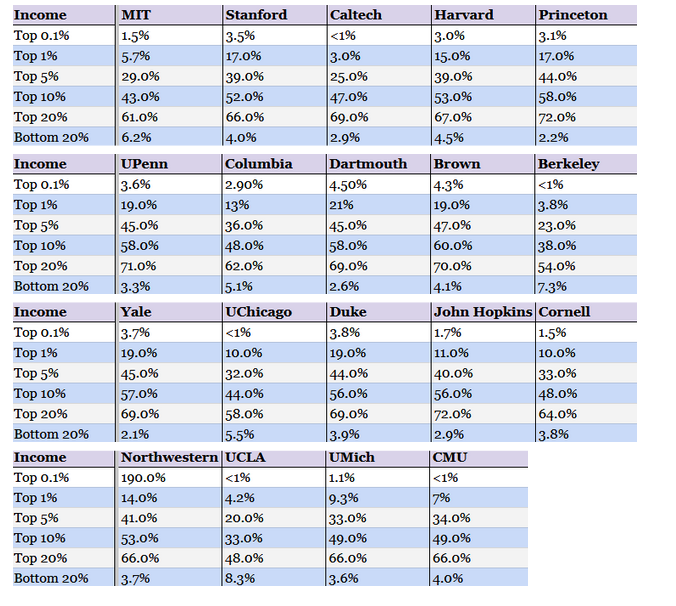
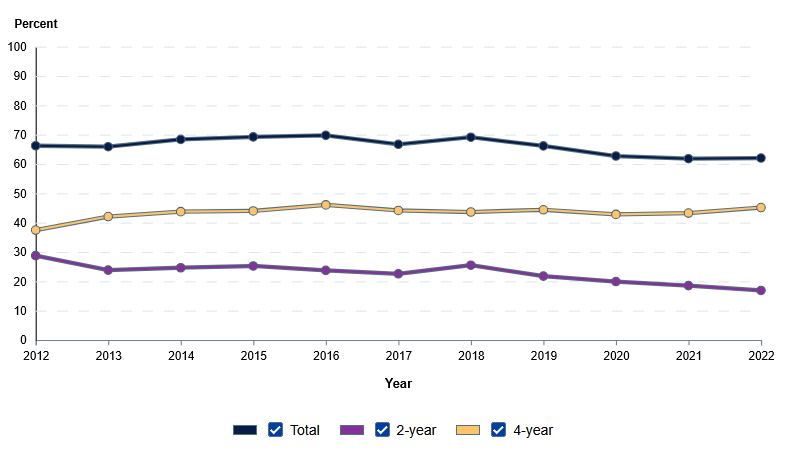
In other words, the working rich and higher are extremely overrepresented in elite universities. These numbers are extremely alarming. Keep in mind that somewhere around 45% of high schoolers do not even get the opportunity to attend a four-year college.
- S. Carrillo, NPR (2023). After a disastrous testimony, three college presidents face calls to resign.
- T. Tao, Mastodon (2025). Post.
- W. Mao and V. Paulus, The Harvard Crimson (2025). Harvard President Garber Tells Faculty He Is Not Considering a $500 Million Deal With Trump.
- K. Tsui, CNN (2025). What we know about the federal detention of activists, students and scholars connected to universities.
- The New York Times (2024). Some Colleges Have More Students From the Top 1 Percent Than the Bottom 60. Find Yours..
- Opportunity Insights. Opportunity Insights.
- National Center for Education Statistics (2022). Immediate transition to college.
- S. Ge et al. (2019). Elite Schools and Opting In: Effects of College Selectivity on Career and Family Outcomes.