Do you ever find yourself getting confused with handwritten notes from professors or peers? Have you ever made a mistake in the interpretation of your own notes because of the way you wrote out a letter or symbol? If your answer to either of these is yes, then you’re spending time deciphering notation in lectures, homework, exams, projects, and labs that could have been used for understanding the actual content.
Why spend valuable time deciphering whether a symbol is meant to be $p$ or $\rho$? Why get mixed up looking back at your notes trying to figure out what is $X$ and what is $x$?
Subjects like fluid mechanics, thermodynamics, electromagnetism, statistics, and pure math are among the worst in this regard because there are a lot of instances where similar-looking letters are repeated. In fluid mechanics, $V$, $v$, $\nu$, $p$, $\rho$, $U$, $u$, and $\mu$ frequently appear in the same workflows. Consider the $y$-momentum equation for the unsteady Navier-Stokes equations in conservative form, assuming constant viscosity:
\[\frac{\partial (\rho v)}{\partial t} + \frac{\partial (\rho u v)}{\partial x} + \frac{\partial (\rho v^2)}{\partial y} + \frac{\partial (\rho v w)}{\partial z} = -\frac{\partial p}{\partial y} + \frac{1}{Re_r} \left( \frac{\partial \tau_{xy}}{\partial x} + \frac{\partial \tau_{yy}}{\partial y} + \frac{\partial \tau_{yz}}{\partial z} \right)\]Now, if you haven’t had the pleasure already, imagine someone with handwriting that is anything worse than exceptional writing this out.
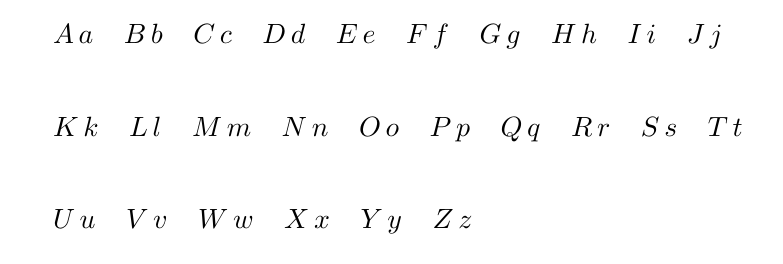
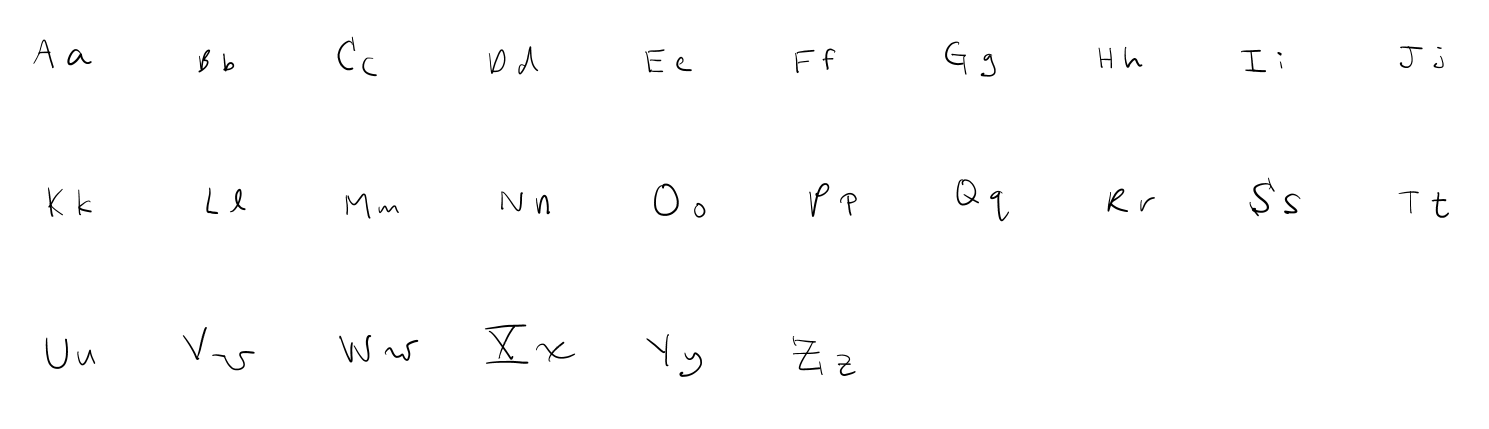
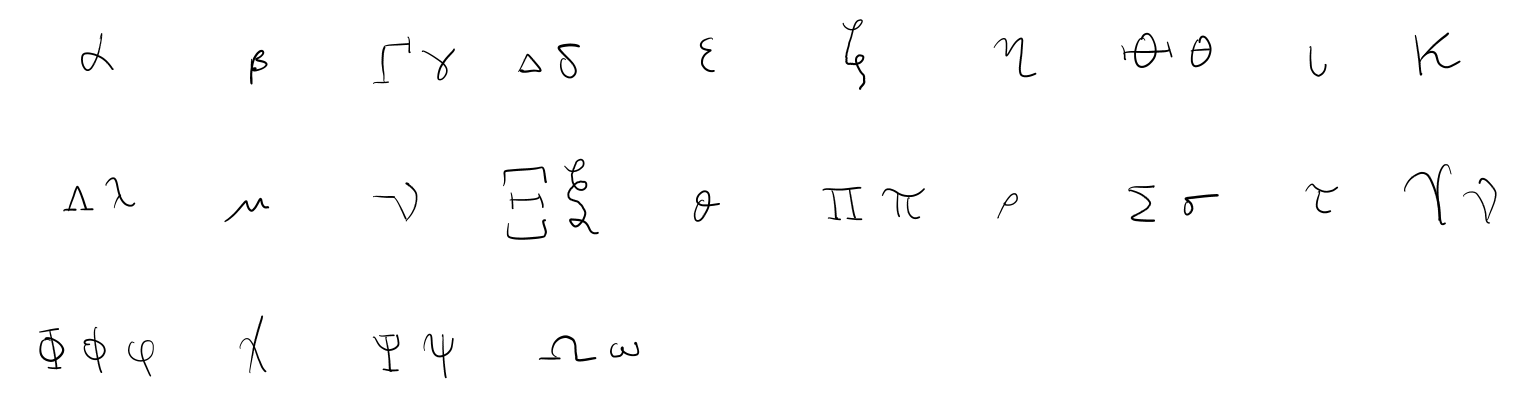
The simplest solution to this is to stay consistent with the way you write your letters and symbols within the document you are working on. Obviously, typing up work when things get bad is far and away the best choice. That often isn’t available, so as a challenge, I’ve tried to come up with the most possibly clear versions of both the English and Greek alphabet that are easily readable and distinguishable for everyone to the point where it is almost unnecessary. Let’s go over some important ideals for this reference. The two primary goals are to distinguish between uppercase and lowercase versions of letters and to distinguish between English and Greek letters. This should not be done using differences in size. When we are handwriting in Roman text, there are letters surrounding others, so it’s easier to tell what is capitalized and what is not. In STEM, we often don’t have that privilege. Thus, we should use serifs to do this whenever we need to. Another important guideline is that the strokes necessary to handwrite these should not be difficult.
English Alphabet
Greek Alphabet
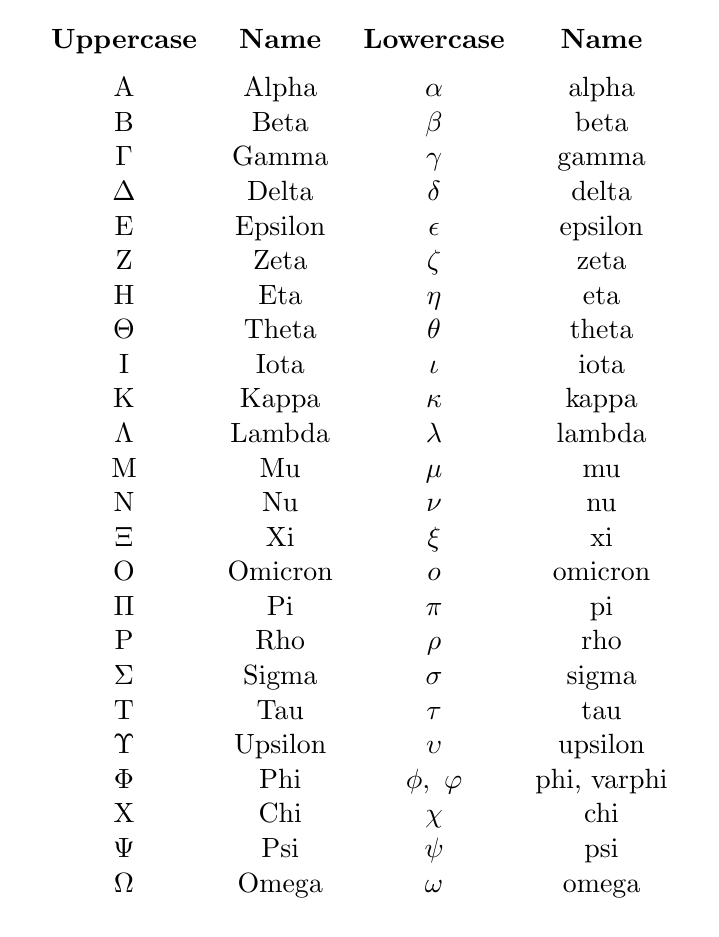
I’ve left out some uppercase Greek letters which are the same as the English letters and not used.
Numbers


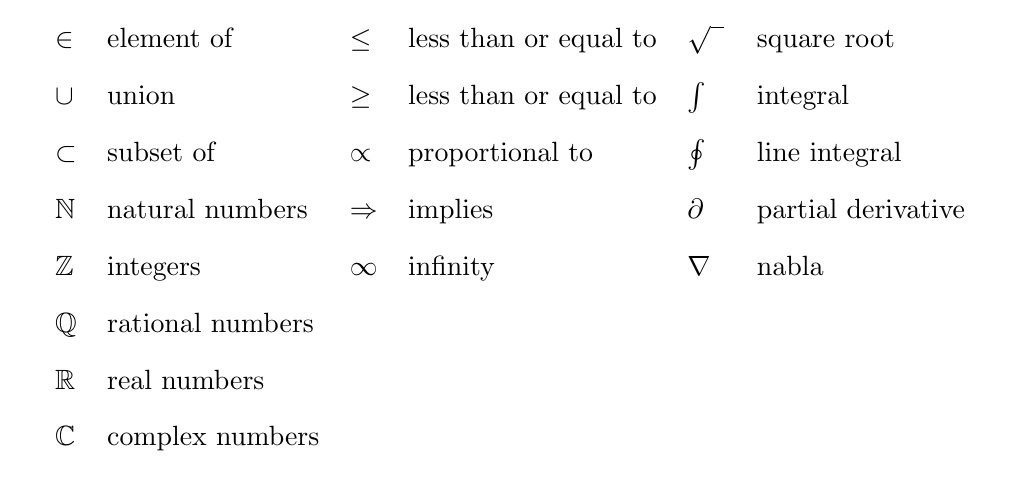
Symbols
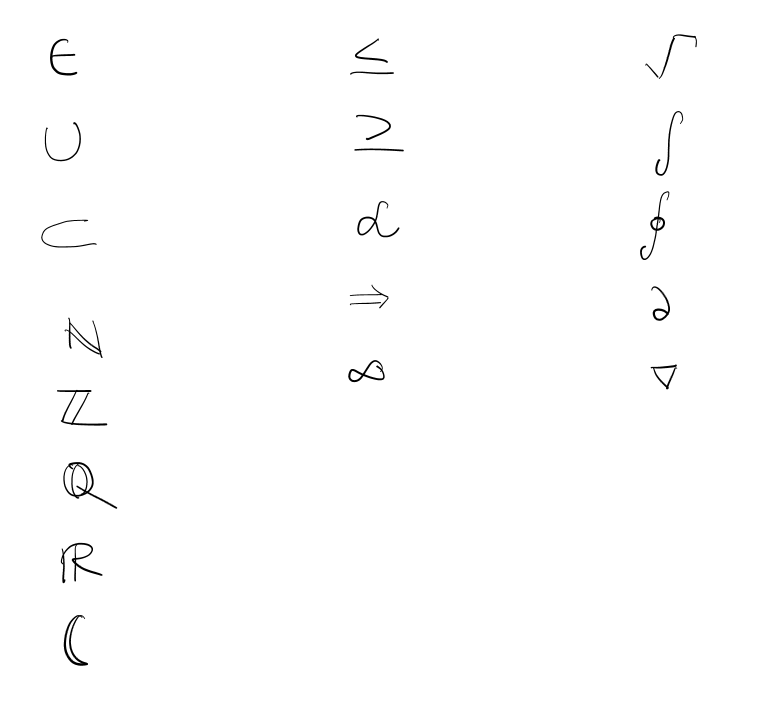
I have genuinely spent several years stressing out over this. The most confusing thing remains distinguishing between $O$, $o$, and $0$. In case you didn’t catch it, we have to unfortunately rely on size to distinguish between $O$ and $o$, while $0$ is very elongated. Additionally, it is often challenging to distinguish between $s$ and $5$, and you have to make sure the first stroke of the $5$ isn’t curved at all.
Advice on Notation and Syntax
Now that we know how to write out what is supposed to be italicized, we face the issue of Roman (upright) text. When we typeset functions, descriptive subscripts, units, and elements (e.g., $\sin$ for the sine function or Al for aluminum), they are upright. We of course cannot reliably distinguish italicized letters from upright letters in handwriting, so deciding whether to keep these cases upright is your choice. I personally prefer to write them upright because there’s usually enough context to tell.
There is still unfortunately room for confusion here, especially when we are tired and more prone to mistakes. It can be difficult to tell what part of an expression is a function or and what part is a variable. Richard Feynman happened to have encountered this issue as a child. He writes the following in Surely You’re Joking, Mr. Feynman!:
“While I was doing all this trigonometry, I didn’t like the symbols for sine, cosine, tangent, and so on. To me, $\sin f$ looked like $s \times i \times n \times f$! So I invented another symbol, like a square root sign, that was a $\sigma$ with a long arm sticking out of it, and I put the $f$ underneath. For the tangent it was a $\tau$ with the top of the $\tau$ extended, and for the cosine I made a kind of $\gamma$, but it looked a little bit like the square root sign.”
We are fortunate enough that context can usually resolve any ambiguities. But I still can’t help but find myself wishing we had another alphabet to make these ambiguities less common in general.
Here are some general tips:
- Try not to add unnecessary loops or curls. For instance, if you add on a loop to the bottom of an $s$, it might look like $\delta$.
- Keep straight parts of letters straight and curved parts curved.
- Finish your strokes completely. Don’t leave space between strokes. For instance, an incomplete $e$ might look like a $c$.
- If you are using all of the following, use $*$ or parentheses or simply place things next to each other for multiplication, $\cdot$ for dot product, and $\times$ for cross product if possible. Write operators that go between letters smaller and centered vertically.
- Use brackets if there are too many parentheses.
- Use parentheses around a function’s argument when the argument contains more than one term.
- Keep your English text left-aligned.
- Start a new line if you are transitioning to a new idea rather than continuing across the page in columns.
- Make equations or expressions part of a coherent sentence rather than just dumping them on the page. You can introduce them using a clause with a colon and then put the equation or expression below. If you don’t think it deserves a full line, embed it into a sentence like you would with a quote.
- Use the standard notation, your professor’s preferred notation, or self-descriptive variables whenever possible. Stay consistent within that document.
- If anything gets too complicated, just define it nearby.
- The number one thing is that you are able to understand your own work, so do whatever works best for you. Just give your future self, colleagues, or anyone else reading it a little leeway too.
I hope this helps, and I’m open to any suggestions.